



![[Translate to English:] Wasser- Warn Sensor und Schalter zum Einsatz an hydraulischen Systemen](/fileadmin/images/fluidcontrol/products/water_alarm_units/tn_ww6.jpg "[Translate to English:] Wasserwarner WW 6") Water alarm unit WW 6Show details
Water alarm unit WW 6Show details![[Translate to English:] Wasser-Warner zur Erkennung von freiem Wasser in hydraulischen Systemen](/fileadmin/images/fluidcontrol/products/water_alarm_units/tn_ww3.jpg "[Translate to English:] Wasserwarner WW 3 / WW 10") Water alarm unit WW 3 / WW 10Show details
Water alarm unit WW 3 / WW 10Show details![[Translate to English:] Gerätekombination zur Feuchte-, Temperatur- und Füllstand-Messung mit zuverlässiger Trennschichtmessung](/fileadmin/images/fluidcontrol/products/water_alarm_units/tn_ww_nivotemp61.jpg "[Translate to English:] Nivotemp 61-0 WW") Nivotemp 61-0 WWShow details
Nivotemp 61-0 WWShow details



FAQ: Water alarms
- What is the purpose of the water detectors in the Fluidcontrol product range?
Moisture and free water are contaminants that have a particularly negative impact on the service life of hydraulic and lubricating oils. In addition, these contaminants significantly reduce the functional properties of oil as an operating medium. For this reason, they must be monitored and controlled as part of condition monitoring.
- How does water get into the oil?
Almost all hydraulic and lubricating oils are hygroscopic and absorb moisture from the surrounding air. In addition, there are numerous applications in which oil reservoirs are exposed to environmental conditions without special protection. Temperature fluctuations can then cause condensation to form on tank or housing walls. Furthermore, there are applications in which water regularly enters the oil as part of the process. If the amount of moisture exceeds the oil’s saturation limit, the water separates as free water and settles at the bottom of the reservoir.
- What can be done about free water?
Ideally, the formation of free water is already considered during the design of the oil reservoir or gearbox housing. The reservoir bottom can be designed with a slope so that, because water is heavier than oil, it collects at the lowest point. If the suction connection of the pump is positioned away from this lowest point, the water can be prevented from being drawn into and distributed throughout the system.
- How do Bühler Technologies water detectors work?
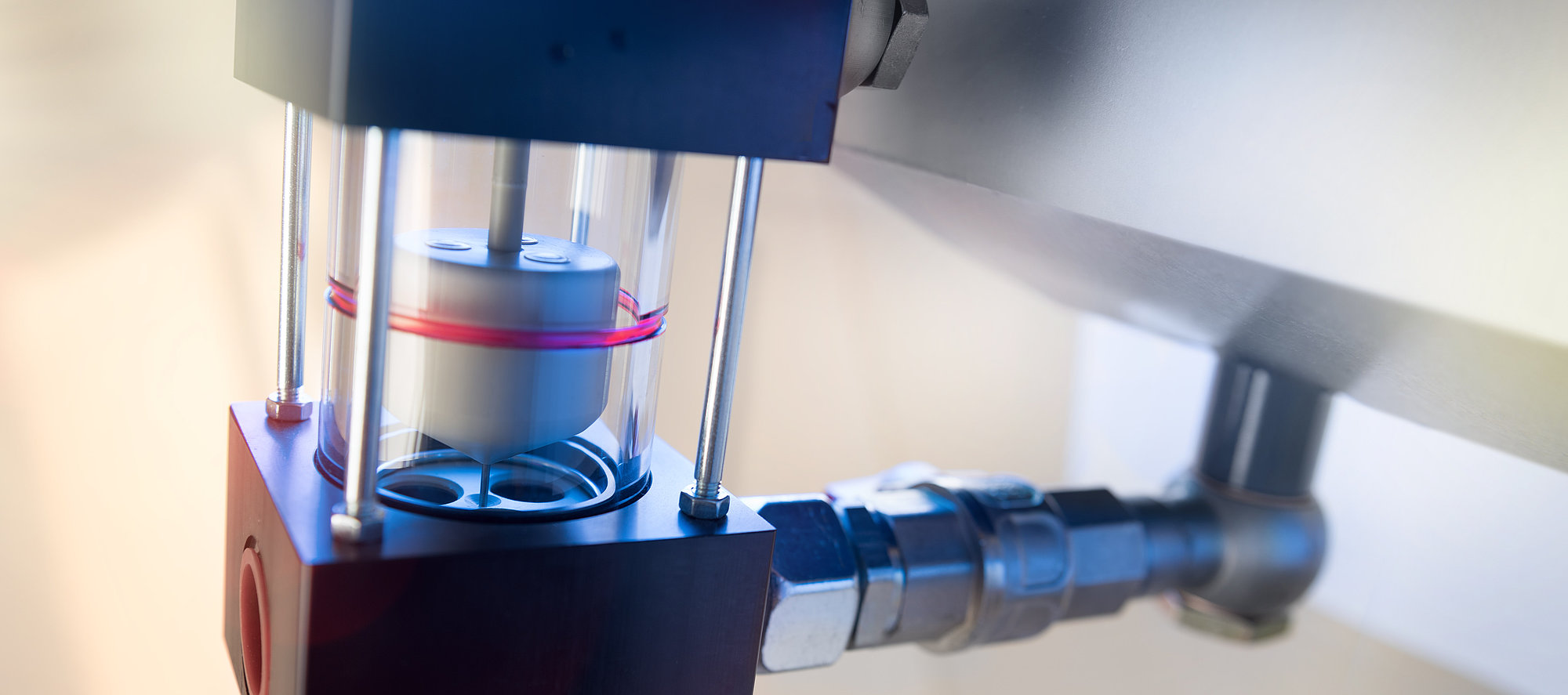
They operate using the physical principle of interface level measurement. A float is calibrated so that it becomes buoyant only in water. The float is installed in a housing outside the oil reservoir and connected in such a way that free water can collect beneath it without remaining inside the reservoir. When the float position is aligned with the reservoir bottom, even a relatively small amount of free water generates sufficient buoyancy to trigger a signal.
- What can the signal be used for?
Depending on the system concept, whether water ingress is expected as part of normal operation or only in fault situations, the signal can be used to activate an automatic water drainage system. Alternatively, it can serve as an alarm indicating a fault condition, prompting inspection of the cause and manual drainage of the water.